A phone call, not another app to learn
Remindly rings their own telephone at the right time and says the reminder out loud — the morning tablets, Thursday's appointment, a glass of water. They answer it with a keypress. For medication, you get an email saying what happened, so checking in does not have to mean ringing to ask.
Free while in beta — no card, no ads, no sales calls. No trial that quietly ends: if charging ever becomes necessary, you will be told first.
Works with what they already have — a telephone, or a tablet if there is one
- You schedule it — the morning tablets, an appointment, a walk after lunch — from your own phone or computer, wherever you are.
- Remindly calls — their own telephone rings at the right time and says the reminder out loud. Nothing to install, and no app store account. If there is a tablet or a computer in the house, Remindly can speak from that instead.
- They press a key — 1 to hear the reminder, then 1 for done or 2 to be reminded again shortly. On a screen it is one big button instead. Never more than one key at a time, and nothing to read.
- You are told — for medication, an email when it is marked done, and another if the time passes and nobody marks it.
Any device with a web browser and a speaker will do — an old tablet, a laptop, the computer already on the desk. Signing in is a link sent by email, so there is no password for anyone to remember.
The limits, before you build anything on this. Calls are made between 8am and 9pm at their end. Nobody is telephoned without agreeing first — the opening call only asks, and never asks for personal details — and pressing 9 on any call stops the reminder calls. How the calls work.
What the call actually sounds like
Eight in the morning. Her own telephone rings.
- Remindly “This is Remindly, with a reminder. Press 1 to hear it.”
- Margaret presses 1
- Remindly “Hello Margaret. This is Remindly, with your reminder. Take your morning medication. Press 1 if you have done it. Press 2 to be reminded again in 10 minutes. Press 9 to stop these calls.”
- Margaret presses 1
- You an email, a minute later: her morning medication was marked done at 8:01.
That is the whole of it. It names Remindly before it asks for anything, because an automated voice telling an older person to press a key is the shape of the calls this age group is warned about — and being recognisable in the first three seconds is the only defence that survives a mobile network stripping the caller ID.
A call nobody answers does not just vanish
If the telephone rings out, Remindly tries again — up to three times, five minutes apart, and only inside the hours above. A voicemail cannot press a key, so an answering machine does not count as an answer and the reminder is never left on one.
When you have marked a reminder as one where being late matters, you are emailed as soon as the first call goes unanswered — while the other attempts are still to come, and the email says how many are still on the way. Once, not once per attempt. That is the whole reason that setting exists: to hear about it early enough to do something, rather than at the end of the day.
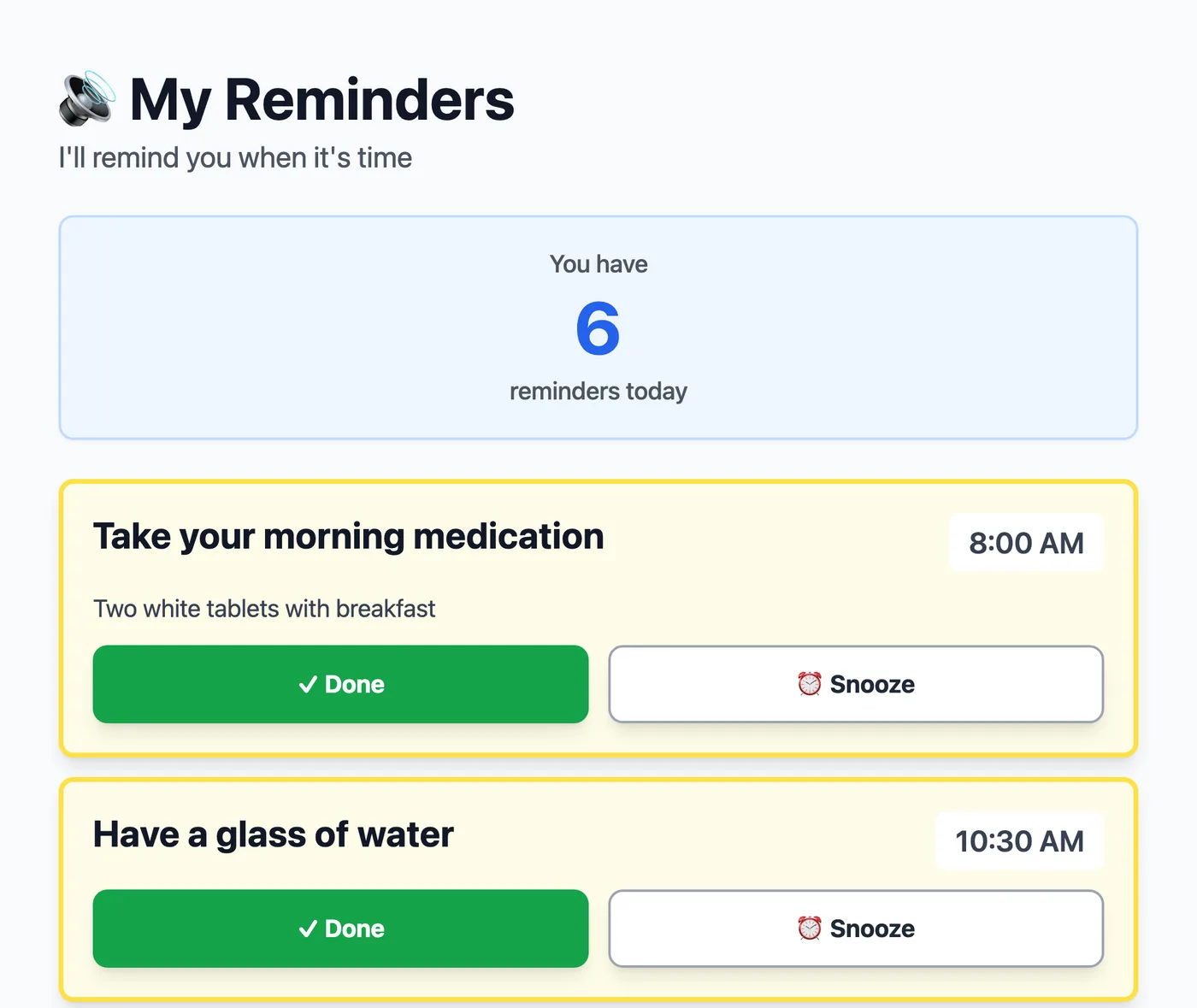
If there is a tablet in the house
A tablet or computer sits somewhere they already spend time — the kitchen table, beside a favourite chair — with Remindly open on the screen, the way a clock sits on a shelf. When a reminder is due, it speaks: "Take your morning medication."
The screen lists the day's reminders in large type, each with two buttons: Done and Snooze. Nothing to install, no password to remember, no menus to get lost in.
What it looks like at yours
You see the whole day at a glance from your own dashboard. For medication, Remindly emails you when a dose is marked done on their device, and again if the time passes and it has not been — so checking in does not have to mean ringing to ask whether they remembered.
What "done" means, and what it doesn't. Remindly records that someone pressed Done on the reminder. That is a good signal and it is not proof: it cannot tell you a tablet was actually swallowed, and it is not a substitute for a pill dispenser, a carer or medical advice. If a missed dose would be dangerous, Remindly should not be the only thing standing between your parent and that dose.
Alongside the reminders that repeat, there is a shared list of the one-off things — a prescription to collect, an appointment on Thursday, the grocery delivery someone needs to be in for. If more than one of you is helping, you can each take what you can and see what the others have picked up.
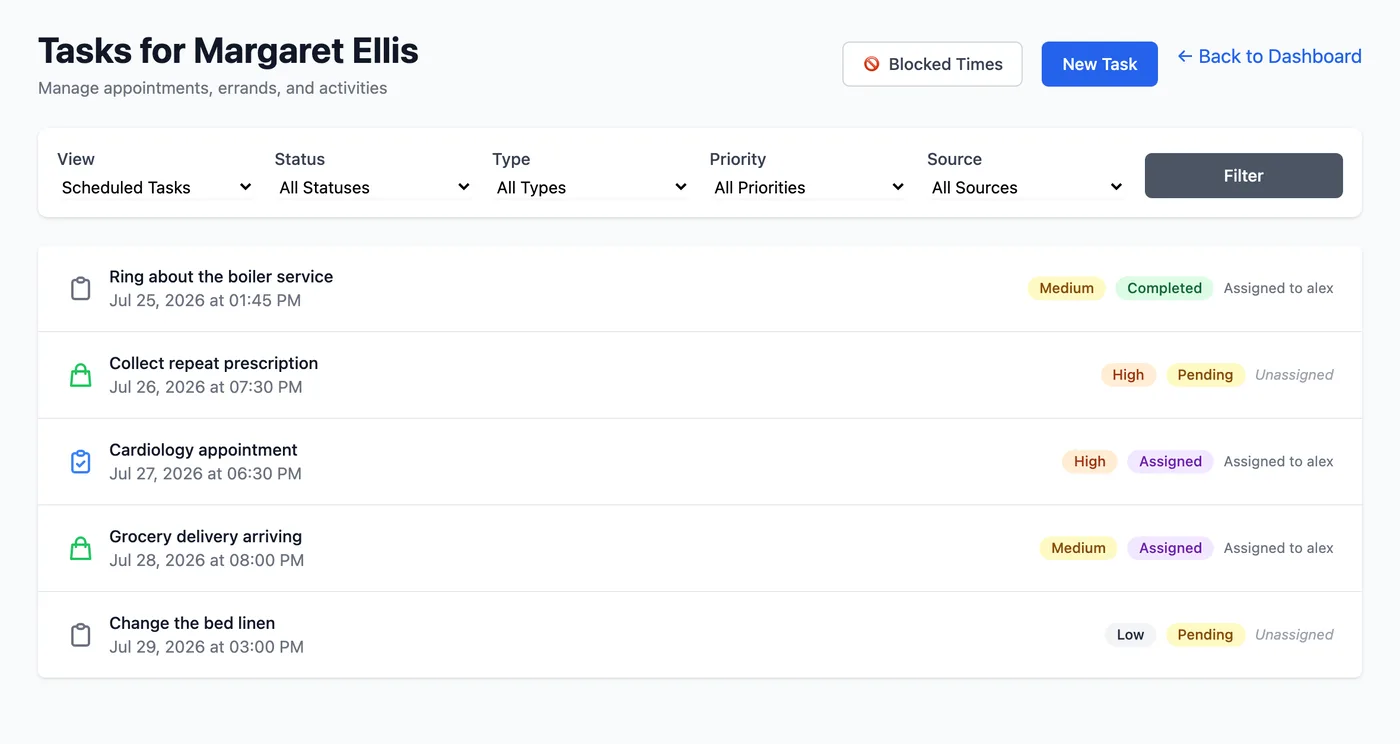
Two things worth knowing before you set this up.
Remindly speaks through the page, so that page needs to stay open on their device — think of it as leaving a clock on the counter rather than an app you open when you need it. Close the tab and nothing is spoken.
And browsers will not play sound until someone has touched the screen, so on an iPad Remindly asks for a single tap after it starts up. It remembers anything it could not say and speaks it once you do.
What it costs
Nothing, while it is in beta — every reminder, every caregiver you link, every email it sends you. There is no card to enter and no trial that quietly ends. If charging ever becomes necessary, anyone already using Remindly will be told first, well before anything changes.
It is early software, and being useful to people matters more right now than being paid for. If that ever changes, anyone already using Remindly will hear it from us first, and well before it does.
If that sounds like there must be a catch, the questions page says plainly why there isn't — along with what Remindly deliberately does not do.
Still comparing options? What a reminder app for an elderly parent actually has to do is a shorter list than it looks, and worth checking against anything else you are considering.
Getting started
Enter your email on the sign-in page and Remindly sends you a link. There is no password to choose or remember, and nothing to install.
The first time you sign in, Remindly asks one question — whether you are setting it up for someone else or will be receiving the reminders yourself — and takes you straight in. No waiting, and you can change that answer later from your profile.
Then you set up the person you care for — their name and their timezone, and that is the whole form. They need no email address, no password and no account. Write their reminders straight away, and hand over access either by opening the link on their tablet and bookmarking it, or by reading them six numbers down the telephone to type in.
Nothing is spoken and you see nothing about their day until they agree, on their own screen, which names you when it asks. If they say no, everything you set up is deleted. That is deliberate: a reminder system arranged for somebody without their knowledge is not a thing Remindly will help you build.
The guide walks through setting up a first reminder once you are in, and the questions page covers what this looks like in practice — including what Remindly deliberately does not do.
Tomorrow at eight, you could already know
Her telephone rings, she presses 1, and the email is with you before the kettle has boiled. Nothing for her to learn, nothing for you to install, and nothing to pay.
The monthly note
One useful thing a month about caring for a parent at a distance, and a line on what has changed in Remindly. You will also get the printable daily routine sheet — though that one is free to anybody, list or no list.